
To say that there are a lot of marketing technology companies out there is a major understatement. To help picture the scale of this expanding universe, here’s just a sample of the players in the field:
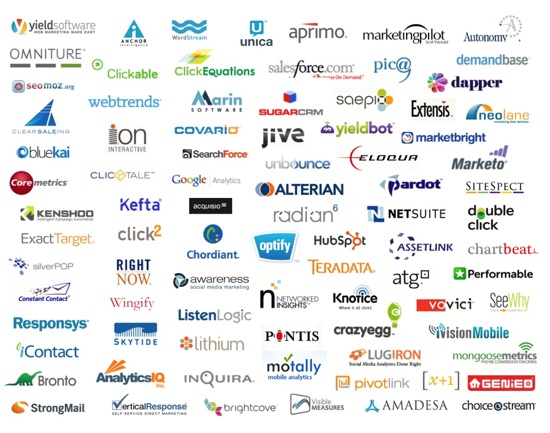
These are merely a fraction of the firms offering marketing automation, web analytics, campaign management, conversion optimization, email marketing, bid management, keyword research, attribution management, behavioral targeting, digital asset management, marketing resource management, social media monitoring — and I’ve left out numerous categories.
And more are on the way.
It makes you appreciate the spectacular sea change that is occurring in marketing. The forces that are driving this Renaissance of innovation and entrepreneurship in marketing technology are the same forces upheaving individual marketing departments and agencies.
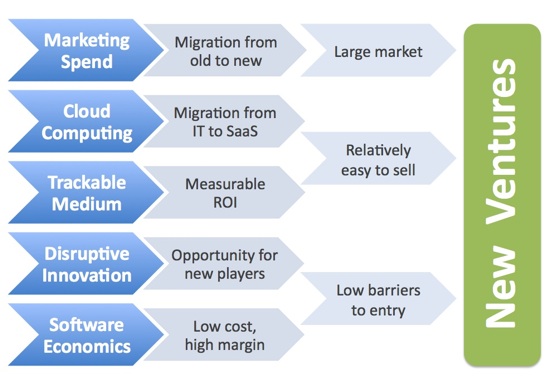
1. Marketing spend. Marketing and advertising spend in the U.S. for 2010 is expected to be about $368 billion — but for the first time, online and digital strategies will get more money ($119.6 billion) than print media ($111.5 billion). This worldwide migration of old media dollars into digital initiatives represents a huge market and transfer of wealth.
2. Cloud computing. With SaaS offerings, marketers can adopt new marketing technologies without having to invest in huge capital expenditures or lengthy (and risky!) on-site IT integration. This dramatically reduces the hurdles to buying — and selling — new solutions.
3. Trackable medium. The tremendous transparency and accountability facilitated by digital channels makes value propositions relatively easy to quantify and measure. The net effect is to make it easier to justify purchases that can deliver results.
4. Disruptive innovation. In a mature market — say, relational database software — it’s harder for new entrants to elbow their way in among the established giants. But in a greenfield market such as marketing software, all of the players are effectively new entrants. This lowers the barriers to entry.
5. Software economics. Generally, it’s a relatively low-cost proposition to experiment with the seeds of new software development. Quickly build a prototype, try it out, and if it works, incrementally build from there. And if it really takes off, the economics of scaling a fixed-cost development are attractive. This too lowers the barriers to entry.
Collectively, these factors create an immensely fertile environment for new ventures in marketing technology.
The result is predictable: there’s going to be a lot more marketing technology flooding the market in the years ahead.
How can marketers, executives, and agency leaders make sense of it all? Now might be the time to consider establishing a chief marketing technologist role — essentially a marketing CTO — as part of your marketing leadership team.
Because when it comes to deciding which of these products to buy, how to configure them optimally for your mission, how to connect the dots between them as part of your unique marketing strategy, and how to extend them with your own proprietary seasoning — you don’t want to leave your fate in the hands of the IT department.
Leveraging this incredible field of marketing technology is ultimately a marketing mission, not an IT mission.
Get chiefmartec in your inbox
Join 42,000+ marketers and martech professionals who get my latest insights and analysis.