
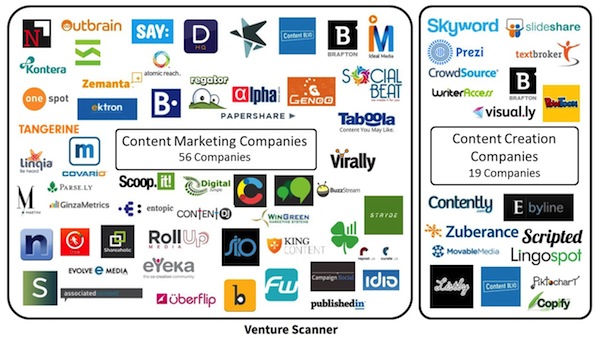
This is a guest post written by Dong Liu of VentureScanner. I was impressed with their research on the many categories of marketing technology, and invited them to give us a helicopter tour of one particularly popular subcategory, content marketing.
A recent study by ContentPlus shows that 70% of consumers prefer getting to know a company through articles as opposed to through ads. Indeed, with the growing importance of content in attracting new customers and engaging existing ones, content marketing has become an area of focus for many businesses’ marketing efforts.
However, it might be difficult to navigate through the dozens of content marketing tools to find the right one for your needs. In this article, I examine the entire content marketing lifecycle from content planning, content creation, content publishing, content promotion, to content analytics, as well as identifying a representative sample of ten tools that could facilitate each step of the process.
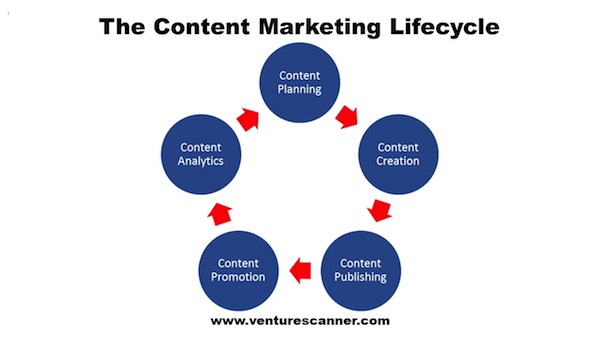
The first step in the content marketing lifecycle is content planning, which refers to how brands and businesses manage and structure their internal content production process. Two tools that could help marketers with content planning are Kapost and DivvyHQ. Kapost provides a platform for content marketing teams to operationalize the content production workflow by assigning tasks to each collaborator, managing assets for the project, and defining deadlines and deliverables. Similarly, DivvyHQ enables marketers to streamline the content production process using a unified dashboard that stores content ideas, provides multiple calendars, and lists out individual content assignments.
After planning out the content production workflow, it’s time for content creation. Whether you create content in-house or outsource its creation to freelancers, there are tools that can help. There are a number of platforms, such as Scripted, which provides businesses with a pool of talented writers who could create any kind of content from 350-word blog posts to 1250-word white papers with professional brand messaging. On the other hand, Content BLVD offers a platform for businesses to integrate their brand marketing into various media partners’ content such as sponsored stories, product placement, and branded entertainment.
When it comes to content publishing on either earned or owned properties, there are two tools that could help: Contently and Sprout Social. Contently is a content publishing platform that enables businesses to publish their content to their CMS and increase its engagement through email marketing, social media, and paid distribution. Sprout Social focuses on publishing content onto businesses’ social media properties and provides features to schedule these posts and increase their engagement by publishing at the most optimal times.
The most important phase of the content marketing lifecycle is driving traffic through content promotion. This is a crowded space but the two companies that could represent the sector are OneSpot and Zemanta. OneSpot enables businesses to turn their content into highly engaging ad creatives and place them in traditional ad spots across its network of publisher sites. Zemanta takes content promotion one step further by being an aggregator of all the content promotion services offered by other companies such as Outbrain and nRelate. Zemanta promotes content in content ads from multiple networks distributed across their publisher sites in a variety of formats such as promoted recommendations, in-stream ads, in-text ads, and sponsored content. Companies such as OneSpot and Zemanta offer a solution to promote businesses’ content as non-disruptive ad units native to the publisher platform and congruent with the user experience.
Finally, it’s time to measure and optimize performance through content analytics. Two tools that could help businesses in this area are Crowdbooster and Traackr. Crowdbooster enables businesses to track and analyze their social media analytics so as to identify their biggest social advocates and determine the best promotion strategy. On the other hand, Traackr gives businesses the ability to discover, engage, and collaborate with relevant influencers so as to maximize the exposure and influence of their content.
As content marketing becomes ever more important in attracting and engaging audiences, it’s key for brands and businesses to systemize the content marketing process. This article highlights a sample of the tools available to optimize the effectiveness across the entire content marketing lifecycle from content planning, content creation, content publishing, content promotion, to content analytics. Identifying the right tool, from the hundreds available, to support your content marketing function is the key to driving revenue through content marketing.
Thanks, Dong!
Get chiefmartec in your inbox
Join 42,000+ marketers and martech professionals who get my latest insights and analysis.