
Because I’m a rambling blogger and not a professional journalist, I’m going to bury the lede — that a recent Gartner report shows larger companies spending more on marketing technology than advertising this year — but I promise to get to it eventually. (Actually, I guess with this disclaimer I didn’t bury the lede. But I digress.)
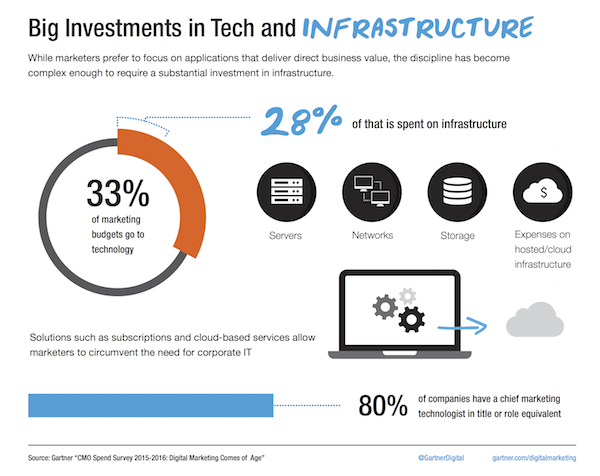
Gartner recently released their CMO Spend Survey 2015-2016, and, of course, I immediately turned to the page on technology investment (pictured above), which had three remarkable revelations:
- Marketing technology represents 33% of the marketing budget.
- 28% of marketing technology spend goes to infrastructure (e.g., servers, storage, network) to run marketing software.
- 80% of firms (still) report having a “chief marketing technologist” role.
Those first two points were actually somewhat surprising to me.
The first question in my mind was: what kinds of companies do these figures represent? Gartner’s survey was based on the responses of 339 marketers from the following industries: financial services (83 respondents), high tech (90), manufacturing (31), consumer goods (30), media (26); retail (62) and transportation and hospitality (17). Respondents came from companies with annual revenue of more than $500 million. Median annual revenue of these companies was $3.5 billion. Respondents were from the U.S., Canada and the U.K.
In other words: large companies, but a broad mix of both B2B and B2C.
On average, they each have total marketing budgets of around $385 million, representing 11% of their annual revenue. (That’s up from 10% of revenue allocated to marketing in Gartner’s 2014-2015 survey.)
This translates into marketing technology budgets of $127.7 million on average.
If you do a very loose back-of-the-envelope calculation — 339 companies with an average $127.7 million marketing technology budget each — that would be around $43 billion in marketing technology spend among these participants. Now, since we’re dealing with medians and not means, and I don’t have access to the raw data, that’s a pretty loose calculation. But as a ballpark figure, it’s conceivably in the right neighborhood. (As a Robert DeNiro character once said, “That’s a very respectable neighborhood.”)
So the second question I had was: what’s in that marketing technology budget?
I reached out to Jake Sorofman, research vice president at Gartner, who kindly provided a more detailed breakdown. The median marketing technology budget of $127.7 million was allocated as follows:
- Marketing and analytics software purchased as a service (24.4%)
- Infrastructure (e.g., servers, storage, network) to run marketing software (28%)
- Cross-charges for IT (21.3%)
- External services to develop, implement, and integrate marketing applications (25.2%)
- Other (1.1%)
As Gartner pointed out in their report, the fact that infrastructure is the largest marketing technology expense is kind of remarkable. More apps, more bandwidth, more computation, more data, etc. Even as cloud-based infrastructure gets cheaper, we’re consuming more of it.
I also found it notable that 21.3% of marketing technology budget goes to cross-charges for IT. On average, that’s $27.2 million a year. So that’s certainly strong evidence that marketing and IT are collaborating on a lot of projects, which is good. Just because marketing is spending a tremendous amount on technology doesn’t mean it’s replaced or sidelined the IT department.
At the same time, 25.2% also goes to external services to develop, implement, and integrate marketing applications. Marketing is spending more on external technology services than internal IT services. Hopefully the decision of internal vs. external resources is made through enlightened consideration of comparative advantage and a firm’s core competencies. (Hey, I’m an optimist.)
And collectively, between internal and external providers, 46.5% of the marketing technology budget is spent on services — which is nearly 90% more than what is spent on marketing and analytics software-as-a-service.
Very intriguing findings.
But, as promised, the most fascinating finding was the answer to this question: if 33% of the marketing budget is spent on marketing technology, where’s the other 67% going?
Jake kindly shared this information on overall marketing budgets too:
- Labor — 35%
- Marketing technology — 33%
- External marketing services (e.g., advertising, paid search, consulting) — 32%
Note that advertising is just a portion of the external marketing services budget, some fraction of 32%. Therefore:
advertising (fraction of 32%) < marketing technology (33%)
Given the respective trajectories of advertising and marketing technology over the past several years, this was inevitable. But still, this is marketing’s crossing of the Rubicon: the die is cast.
Pause for a moment to appreciate that. And then it’s back to the tornado…
Get chiefmartec in your inbox
Join 42,000+ marketers and martech professionals who get my latest insights and analysis.