
What is the role of a chief marketing technologist?
Short version: a chief marketing technologist (CMT) is the person responsible for leading an organization’s marketing technology.
A company may or may not be a “technology” business, but in today’s world it needs to deftly leverage technology in its marketing to:
- optimize its marketing strategy and tactics;
- interface with its audience through digital channels.
In a wired world, marketing must be technology-savvy for a business to compete.
This parallels another movement in the enterprise, which is to elevate “marketing” beyond a function isolated in a specific department — e.g., throw it over the wall to marketing and back again — into a broader organizational capability. Marketing needs to be about continual growth and innovation, and that marketing-driven mission needs to permeate all areas of the business. Think Apple. Starbucks. JetBlue.
Combined, the embrace of marketing technology and the transformation of marketing to a primary driver of competitive advantage is the essence of New Marketing — marketing without borders.
But what constitutes “marketing technology”?
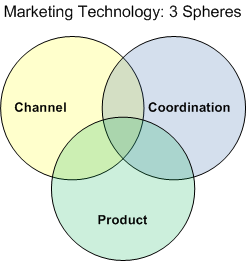
Part of the challenge is that the breadth of applications that now reside under the domain of marketing is incredibly diverse. I think of marketing technology as generally belonging to one of three spheres (or overlaps between them):
- A channel to the market.
- An internal coordinating device.
- An integral part of the product.
Marketing technology as a channel is using digital media — primarily Internet-based — to reach and engage with prospects and customers. Examples include:
- the web site;
- online advertising;
- search engine marketing;
- post-click marketing;
- behavioral targeting;
- social networking;
- online communities, forums, wikis;
- email marketing;
- syndicated content;
- mobile marketing;
- semantic marketing;
Marketing technology as a coordinating device is designed to organize and optimize the planning, execution, and analysis of everything marketing does — to process-ize it, measure it, improve it, and accelerate its clockspeed. Examples include:
- web analytics;
- business intelligence;
- customer relationship management;
- campaign management;
- competitive intelligence;
- sales force automation;
- digital asset management;
- content management;
- marketing/sales dashboards;
- marketing resource management;
- enterprise marketing management;
Marketing technology as a product is the embodiment of marketing principles into the product or service itself — such as e-commerce experiences in online stores. This is common in technology companies and pure Internet businesses, but increasingly firms in other spaces are offering complementary digital services as a competitive advantage as well.
These technologies may be based in several different operational areas:
- the marketing department;
- the IT department;
- the cloud: hosted applications and software-as-a-service;
- product operations (where applicable);
Wherever they operate, however, they are identified by being under the authority of marketing. The chief marketing technologist is responsible for the technical governance of this entire field of marketing technologies. This position must be headed by an equal blend of a marketing-savvy technologist and a technology-savvy marketer — a senior marketer-technologist leader. The main goals of this centralized, marketing-centric IT governance include:
- keep marketing technically competitive in all relevant application areas;
- facilitate useful interoperability and synergy between these applications;
- advocate for and adopt new technologies that drive growth and innovation;
- enable everyone else in marketing to leverage technology for their goals;
- navigate the lifecycle of marketing apps from one generation to the next;
- accelerate the overall clockspeed of marketing through technology and processization;
The chief marketing technologist works with the senior executive leadership at 2 or 3 key touchpoints:
- with the CMO to align marketing IT governance with marketing’s business objectives;
- with the CIO to align with IT’s infrastructure and broader technical governance requirements (e.g., security, business continuity);
- where applicable, with the product development team to incorporate and leverage marketing technology as a product and within products.
In companies where such roles exist, a chief strategy officer and/or a chief innovation officer may also participate in the marketing IT governance council.
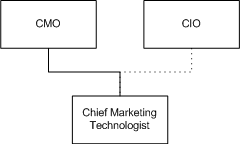
Although the chief marketing technologist needs to collaborate across the enterprise, the position needs to firmly sit under marketing. This role must serve the marketing agenda, and therefore it must be primarily accountable to the CMO. (The relationship of the CMT to the CMO seems analogous to the role of a CTO to a less technical CIO in IT-intensive organizations.)
Depending on the structure of the organization, it makes sense for this role to have dotted line or matrix reporting to the CIO.
However, I do not believe marketing technology should be led by the IT department. IT certainly has an essential role to play, taking responsibility for a company’s overall computing infrastructure — the network and server and platform underpinnings of much of what makes marketing technology possible. IT can also broker compatibility and synergy between marketing technology and operations technology. But the databases and applications that run marketing need to belong to marketing: authority and accountability must be linked.
In a small company, the CMT hat might be worn by someone with other responsibilities — a director of marketing, web marketing, or perhaps even a technically-astute CMO. But once an organization achieves any significant scale, the chief marketing technologist is a full-time role. (If it’s not, your company is probably losing competitive ground in the marketing dimension.) For larger firms, the CMT will head up an entire team of marketer-technologists.
Who’s leading marketing technology at your organization?
Get chiefmartec in your inbox
Join 42,000+ marketers and martech professionals who get my latest insights and analysis.