
What is "semantic advertising"? (Or, advertising encounters of a semantic kind.)
The short answer: advertising that uses semantic web technology, of course. But as it turns out, that definition is highly dependent on how you define "advertising" and "semantic web".
With a flurry of innovation happening in both these areas — and their intersection — there are now several different meanings for semantic advertising, depending on who you ask.
Here are 4 distinct kinds of semantic advertising:
#1: Contextual advertising with semantics
Several ad networks — Google's AdSense being the most popular by far — automatically analyze the content of web pages to dynamically determine which ads are the most relevant to serve there. If I'm on a site reading about LCD televisions, they show me ads for retailers who sell them — without the publisher or the advertiser (or even the ad network) having to explicitly specify anything. This is really just contextual advertising, but when it uses semantic technology to determine the context, it's called semantic advertising.
This is probably the most common interpretation of semantic advertising today.
Ad networks such as Peer39 and adpepper's iSense have really emphasized their use of semantic technology as a competitive advantage under this banner of semantic advertising. For the most part, their semantic technology consists of proprietary algorithms for natural language processing. It doesn't have anything to do with the Semantic Web as Tim Berners-Lee would describe it, although an argument could be made that it does implement a top-down semantic web approach.
[Update: in response to this post, Ian Saunders, one of the co-inventors of iSense, posted an excellent comment below with a more detailed explanation of their approach.]
Now, if site publishers were to add semantic data to their sites via a bottom-up approach of RDF tags and/or microformats — which will happen once the business incentives for doing so are compelling enough — then that metadata could be used to increase the accuracy of contextual ads even more. This would have the benefit (and some potential trouble) that publishers could give semantic ad networks hints about the semantic meaning of content on a page, leveraging true semantic web standards.
#2: Semantic search advertising
A new generation of semantic search engines such as Powerset and Hakia are trying to leverage semantic technology to provide people with a better search experience. This seems to be gaining traction, particularly in vertical search, where the meaning of words and relationships can be disambiguated relatively easily — for example, the job search site Trovix.
Of course, the business model for these semantic search engines almost certainly ends up being advertising. And if you advertise on a semantic search engine, that's semantic advertising, right?
Maybe. The interesting twist is that advertisers in semantic search may ultimately end up bidding on concepts and relationships rather than keywords or phrases. Now that is actually a pretty cool concept of semantic advertising.
#3: Dynamic advertising content
One of the goals of the Semantic Web proper is to facilitate programmatic exchange of data across the Internet. By making the web more "machine readable" — above and beyond the human readable content of the web we love today — it can foster a new era of smart, connected software applications.
Jonathan Mendez of RAMP Digital has applied this concept to dynamically feeding content into interactive Flash ads, and he has called them semantic ads. The idea is that an advertiser — particularly a retailer — can expose their latest offerings and inventory as XML semantic data, and then the creative person or agency who makes an interactive ad can read this data behind the scenes to dynamically change the content of the ad accordingly.
This is an advertising-specific incarnation of a tried-and-true principle in web development: the separation of presentation and data. As advertisements become more data-rich, this makes the job of maintaining them more manageable.
Someone in the advertiser's IT department takes responsibility for publishing the latest data. Someone in the marketing/creative team takes responsibility for displaying that data in the coolest way possible. Once both parties agree on the format of the data, it requires relatively little coordination for updates to happen on either side.
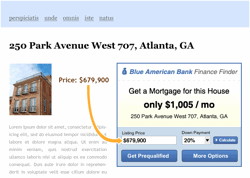
This could be even more powerful if the format of the semantic data for these ads were standardized across multiple advertisers, perhaps even across multiple industries. That way, a marketer could create awesome data-rich ads without ever having to explicitly coordinate with a company's IT department. This could also enable groovy "mashup ads" that leverage data from multiple sources — say a retailer and the various manufacturers' brands it sells.
Dapper's MashupAds platform is one possible incarnation of this with a more standardized approach. There's a good article on ReadWriteWeb about their strategy to have advertising drive the adoption of the semantic web.
#4: Advertising inside semantic data
When I wrote my article on semantic marketing earlier this year, my vision of semantic advertising was the paid placement of data into authoritative sources of semantic data:
Perhaps this will lead to a new type of semantic advertising? People paying to have their semantic data distributed through certain networks, tagged with certain metadata under the authority of the network owner. I believe there are vast entrepreneurial opportunities for vertical market networks here.
This is an entirely new channel of advertising, and as such, it's hard to picture in the abstract. So here are a couple of examples.
Yahoo! recently released SearchMonkey, which enables search engine results to have more context-specific structure. For instance, a restaurant result from Yelp might contain ratings, address and phone number, a thumbnail, links directly to user reviews, etc. This more structured information is provided by Yelp to Yahoo! as semantic web data.

In this scenario, Yelp has become a powerful authority of semantic data on restaurants. The semantic data they expose to Yahoo! ends up having a significant impact on how users get their first impression of a restaurant in the search results.
So what if Yelp charged restaurants to include additional data elements in these listings? For instance, imagine an optional "web coupon" link that could appear in these search results if the restaurant paid for it. This would help the restaurant stand out even more, and hopefully compel searchers to act on the opportunity for a special offer.
Now Yelp may or may not want to do exactly this, and Yahoo! may or may not allow it, but this illustrates a new kind of semantic advertising. The coupon information is actually machine-readable semantic data being published by Yelp — that Yahoo! is then eventually displaying to end-users. But other sites might also take advantage of Yelp's semantic data, further propagating the value of that embedded coupon.
For another example, consider Thomson Reuters' OpenCalais project. OpenCalais is an application that takes plain HTML pages — such as a blog page — and generates semantic web metadata for the named entities (e.g., people, companies, geographies), facts, and events that it identifies.
Semantic advertising in this context would be permitting advertisers to include sponsored metadata in these results. So, for instance, if a semantic reference to a company was going to be included in the metadata results generated by OpenCalais, that company could pay OpenCalais to include additional metadata. Or, more intriguingly, advertisers could bid to associate additional metadata with other facts or events — consider how sporting events would be a great opportunity for someone like Nike to provide semantic references to licensed merchandise.
Again, Thomson Reuters may or may not choose to do this. But it's certainly conceivable that they could. And there's no doubt that other semantic data authorities will.
In many ways, I believe this type of advertising is the most accurate definition of "semantic advertising", since the advertising itself is semantic data embedded inside streams of semantic data.
But all 4 of these types of semantic advertising will be fascinating to watch as they evolve.
Get chiefmartec in your inbox
Join 42,000+ marketers and martech professionals who get my latest insights and analysis.