
Last week, I gave my talk at Search Insider Summit on the Rise of the Marketing Technologist. Based on the positive feedback I received from brands, agencies, and technology vendors alike, it apparently resonated deeply.
So, first, I’d like to share the slide presentation with you:
However, since slides can’t capture the full dynamics of the presentation, I thought I would follow with an essay version of my talk as well.
Rise of the Marketing Technologist
My premise is simple: marketing must control its technological destiny.
In the past few years, marketing has been flooded with a deluge of marketing technologies. The logos below provide merely a sample of the breadth of these offerings:
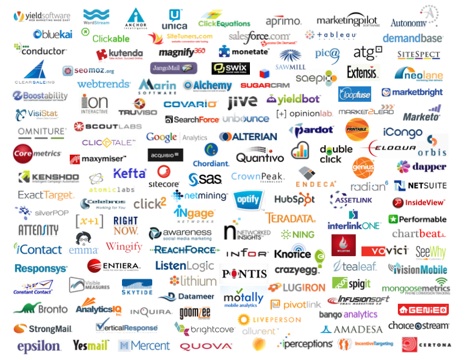
And more innovations are pouring in every day. Five forces in our industry have combined to create a perfect storm for marketing technology:
- the migration of money from old media to new media
- cloud computing and the migration from IT to SaaS
- the measurable nature of digital to demonstrate ROI
- a greenfield of opportunity for new entrants
- the high-velocity economics of software innovation
Taken together, this reveals a huge market — growing larger every year — with relatively low barriers to entry. It has only begun to be tapped. The result, predictably, will be an explosion of marketing technology products and services over the next 5 years.
It can seem a little overwhelming.
But wait, there’s more…
Marketing technology isn’t just software you buy — it’s also software you create. Web applications, widgets, Facebook apps, iPhone apps, Android apps, interactive ads, the semantic web, and even the connected features of your products are now part of marketing’s realm.
Digital marketing has grown far beyond the web site. As marketers, we now manage a vast, extended web that includes landing pages, microsites, social media outposts, mobile apps, dynamic ads and more. I view this as a kind of solar system model, with many platform planets orbiting your central marketing strategy.
And new planets seem to enter our gravitational field every year. This year, the iPad and tablet computing are emerging as the latest satellites in orbit.
3 Spheres of Marketing Technology
All these technologies — the ones we buy, the ones we build upon — can be categorized into three overlapping spheres:
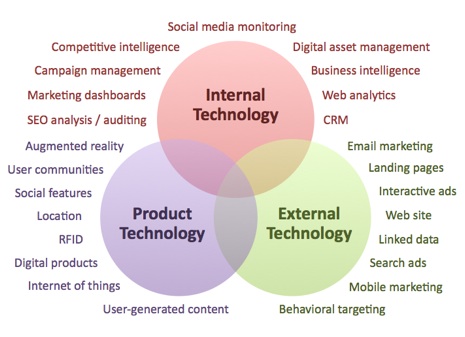
Internal technology is what we use to manage and analyze marketing operations, such as analytics, SEO auditing, competitive intelligence, and social media monitoring. External technology includes the platforms we use to reach our audience and deliver content — web sites, ads, landing pages, email campaigns, and apps of all kinds.
And, in many markets, there’s a blossoming new domain of product technology — features that are built into your very products and services, which directly feed into your marketing ecosystem. Social sharing features. Location features with GPS. RFID and participation in The Internet of Things. Purely digital products with inherent viral capabilities.
We’re talking about a lot of different technologies.
Yet in the big picture of marketing, the real challenge isn’t the individual components — it’s how these different pieces fit together in your unique enterprise. When you connect the dots, do you get a prince or a frog?
Technology Decisions in Marketing
A number of people have remarked that marketing seems to be getting harder. More fun, but harder.
One of the reasons it’s getting harder is because of the growing number of technology decisions marketers must struggle with. It wasn’t too many years ago that there were only a handful of choices — which CRM to use, which content management system (CMS) to adopt, which web analytics provider to choose.
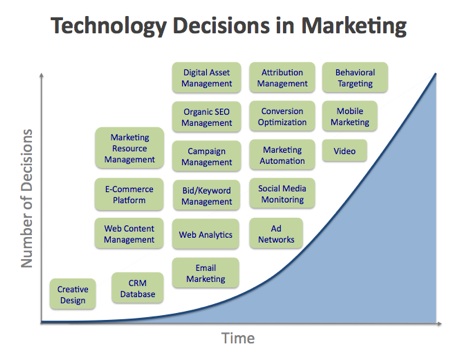
But recently, the number of marketing technology decisions has skyrocketed. Marketers have more application and platform decisions to make than ever — bid management, campaign management, conversion optimization, attribution management, marketing automation, social media monitoring, behavioral targeting etc.
Every time a new platform or application arrives on the field, the decision space actually grows exponentially. Because again, it’s not just decisions about individual components — but decisions about their interactions with each other.
These decisions have significant consequences.
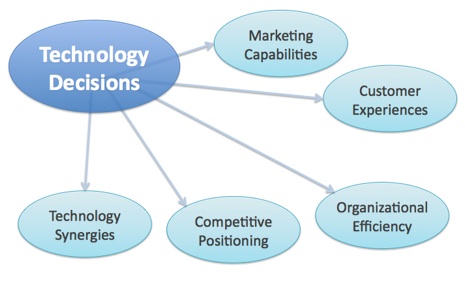
They determine what marketing capabilities your firm will have. They shape the experiences that prospects and customers will have with you. They impact your organizational efficiency and competition position. And they open (or close) the door to synergies with your other technology choices.
In other words, technology decisions and marketing strategy are intertwined. You can’t address one without impacting the other.
But who makes these decisions?
- Marketers
- IT department
- Web shops
- Technology vendors
- Ad hoc
And on what basis do they make those decisions?
- Marketing vision
- Technical depth
- Right incentives
- Business alignment
- Accountability
Marketers have the vision, incentives, accountability, and alignment — but often lack the technical depth. The IT department has plenty of technical depth, but different incentives. Web shops, agencies, and technology vendors may have a good mix of marketing vision and technical depth, but their business alignment has a different vector than yours.
But no one party brings all of these factors together.
Now, since each of these players has some of the pieces, it might be suggested that the solution is to bring everyone together for a big meeting and let the answer emerge from consensus. Not to sound too skeptical, but I call that the U.S. Congress Model of Decision Making.
Contention doesn’t necessarily lead to invention. It usually leads to deadlock or the lowest common denominator.
Digital Marketing: Like IT or Product Development?
Speaking of contention, any discussion of marketing must address the frequently broken relationship between marketing and IT.
I’ve written before on why marketing and IT are diametrically opposed — the tension between marketing and IT is actually quite natural given the way most organizations are structured. IT and marketing simply have different incentives and priorities.
IT is primarily concerned with stability, security, economy, standardization, and functional specs. Marketing is more concerned with speed, agility, innovation, market impact, differentiation, and customer experience. It’s not that IT doesn’t appreciate marketing’s priorities — or vice versa. It’s just that their incentives cause them to value their own respective priorities more.
But the relationship between marketing and IT isn’t the only way to manage technology.
For example, Apple has a terrific IT department. But IT didn’t create the technology of the Mac, the iPod, the iPhone, the iPad. To be sure, they provided logistical support to how those products were delivered. But the creation of the technologies themselves came from the product development team.
Product development and IT engineers — even though they’re both technologists — are quite different in what they do and how they do it.
I believe that digital marketing is more like product development than IT because it is:
- More front-office than back-office
- Experienced directly by customers
- An engine for new revenue
- Integral to the brand
- Visible in competitive positioning
- A creative endeavor
And that parallel suggests a way forward for the future of technology-powered marketing.
Marketing Must Lead Marketing Technology
Marketing must take ownership of the technology in its domain.
As marketers, you’re already responsible for the outcomes based on such technology. The accountability so widely promoted in digital marketing has you in the hot seat for results. It’s only sensible that you should have full control over the means and mechanisms to deliver those results.
You must be the driver of marketing technology, not merely a concerned passenger. But if you don’t have technical depth, who can help you navigate?
I propose a new role in the marketing department: a marketing CTO or chief marketing technologist. The mission of the marketing CTO is to provide that technology navigation.
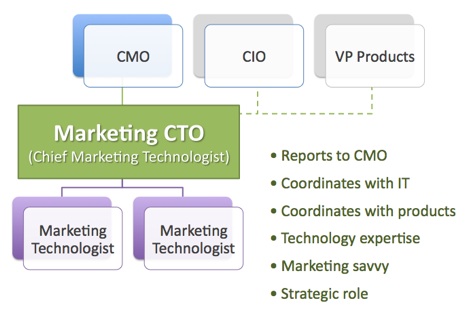
The marketing CTO would report to the CMO, not the CIO — although he/she would certainly collaborate with the IT department (and, increasingly, with the product development group). This person would be a technologist, with a strong background in software and technology management. But their focus, passion, and allegiance would be to the marketing mission.
The marketing CTO would be perched at the intersection of those three spheres of marketing technology, providing the technical leadership to orchestrate and optimize them.
I’m not the only one who thinks this role is crucial to marketing’s future.
Earlier this year, Avi Dan — who’s been an executive at Young & Rubicam, Saatchi & Saatchi, and other leading agencies — wrote an editorial in Advertising Age titled Why Brands Should Embrace Technological Change. In it, he advocates:
CMOs must… recognize that technology is no less a marketing tool than, say, market research, and appoint a marketing-technology czar to champion it… to act as a cross-functional facilitator and identify technology that can enhance marketing activity and brand building.
A group of researchers at the MIT Sloan School of Management came to a similar conclusion in an article that was reported in The Wall Street Journal as The Secrets of Marketing in a Web 2.0 World:
Who should direct… Web 2.0 marketing? [An executive with skills] beyond those of a typical MBA holder or tech expert. We coined the term marketing technopologist for a person who brings together strengths in marketing, technology and social interaction.
The Role of the Marketing CTO
To be clear: I’m not proposing another layer of management in marketing. I believe it’s a flat organization world. And I’m certainly not advocating for a new C-level position — the CMO is the right person to be the unequivocal leader of all marketing.
Instead, I am suggesting that technology become one of the vertical pillars of the marketing function — with the marketing CTO as its head.
Resources that used to be begged, borrowed, or bought would instead become a native part of the marketing organization. If you don’t ascribe anything mystical to technology, and simply treat it as a talent and skill set of the new marketing — part of the natural shift from old media to new media — then this is a completely logical move.
I do think it’s better to think of this capability holistically as marketing technology, rather than breaking it down into separate specialties. Like the other facets of marketing, I believe the shift from strict silos such as search or social to a more integrated approach is important. There will always be some specialization, but the real potential is in broadly connecting the dots.
Now, this new technology branch of marketing doesn’t have to implement everything. It will develop some software — particularly the glue between disparate components — but it will also work with IT, the product team, outside agencies, technology vendors, and contractors.
The difference from before is that marketing will now have “positive control” over the full technical dimension of these other participants — not just at a high conceptual level, but at a technology implementation level too.
Instead of marketers having to take what those other technologists say at face value — which leads to challenges when incentives and end-to-end business objectives are not perfectly aligned — the marketing CTO can provide checks and balances. Timeframes, technical specifications, architecture choices, and final deliverables can all be reviewed by an expert who is perfectly aligned with marketing’s agenda.
The marketing CTO is the person who combines marketing vision and technical depth to direct the entire landscape of a company’s marketing technology portfolio.
Ultimately, the goal of the marketing CTO is to enable the CMO to wield technology as a strategic marketing capability. This can be analogous to the relationship between a less-technical CIO and his or her CTO, or between a product CTO and the CEO. If the chemistry is right, this is a powerhouse combination.
Building a Technology Culture in Marketing
But while a marketing CTO can be a great change agent, catalyst, and leader for this new branch of marketing, integrating technology more deeply into the marketing function isn’t a one-person show. The future of marketing is having technologists seamlessly embedded throughout the marketing department — collaborating in synchronized harmony across many teams.
I’m not saying that everyone in marketing needs to be a technologist — just like not everyone in marketing has to be a “creative.”
But even though not all marketers have a background as a graphic designer or art director, such creative capabilities are deeply interwoven into the culture of marketing. We appreciate them and collaborate with them. A CMO doesn’t need to have been a Chief Creative Officer, but he or she must know how to manage and lead such resources.
That is how marketing must embrace technology — as a new fundamental building block of its DNA. Technology must become infused into marketing’s culture.
Arthur C. Clarke, who wrote 2001: A Space Odyssey, once said, “Any sufficiently advanced technology is indistinguishable from magic.” Any marketer who has relied on cut-and-paste scripts for web analytics or conversion optimization knows how that feels first hand.
The danger with adopting such a black box approach to marketing technology — I don’t know how it works, it just works, sort of, I think — is that it obscures risks and opportunities, breeds superstition, and makes it difficult to reveal and leverage interdependencies.
By incorporating technologists throughout marketing, across many teams — and by embracing their talents and skills as part of the essence of new marketing — marketing can go from being in the audience of the magic show to being the magician on stage, performing feats with dextrous precision that cause your customers to “ooh” and “ahh.”
Marketing Agility and the Future
Speed and agility are increasingly at the heart of marketing’s competitiveness.
A key benefit to empowering marketing with its own technical talent will be an acceleration of the clockspeed in implementing technology-based programs. Part of this speed-up will be purely organizational — having engineers directly on your team, sitting right next to you, perfectly aligned with your mission is bound to be faster than the slow and arduous process of constantly crossing organizational boundaries and vying for the attention of people who are not 100% focused on your goals.
Managing technology resources under marketing’s umbrella will — to talk tech — minimize switching costs and reduce communication latencies.
However, there is a deeper level at which technologists can contribute to marketing’s agility: introducing agile methodologies into marketing operations and management. Just as agile software development made the process of creating software more nimble than the rigid and time-consuming “waterfall” approaches that preceded it, agile marketing can accelerate the operational tempo of marketing.

After all, since more and more marketing is implemented through technology, it makes sense that iterative and flexible processes derived from agile software methodologies — such as the scrum approach illustrated above — will thrive in the modern marketing ecosystem.
Similarly, since the trackable and malleable nature of digital marketing lends itself so well to controlled experiments, A/B testing, and multivariate testing, marketing can re-interpret and leverage the concepts of test-driven development from software engineering to systematically feed continuous improvement.
Even ideas from open-source software may be successfully adapted in a marketing context.
The overarching vision is that the cross-pollination of marketing and technology cultures will lead to innovative hybrid models of marketing technology management that are indigenous to this new era of marketing.
And the value of developing such innate technical savvy will only increase as scale and scope of marketing technology grows.
One of the most fascinating fields of research today is at the intersection of computer science and marketing. This is the emerging field of computational marketing — somewhat analogous to the revolution of computer science and finance that birthed the industry of computational finance.
Computational marketing can leverage the tsunami of big data with real-time experimentation, optimization, and personalization — intertwined with human marketing expertise and judgment — to transform this industry over the next 10 years.
Thanks to the economies of cloud computing, these computational marketing capabilities will not be limited to a handful of the Fortune 500. Marketers of any size will be able to utilize them — if they know how.
Embracing Marketing Technologists Today
If I’ve persuaded you of the potential of this future, your first question may be: where do we find these mythical creatures called marketing technologists?
Of course, few people have those titles today.
But the talent, skill set, and experience that we’re looking for does exist out there. A whole generation of web developers and web entrepreneurs have developed these commingled capabilities — out of necessity and desire. They often have a formal engineering background followed by business or marketing graduate studies or in-the-trenches experience.
Many of them have already infiltrated marketing, perhaps through an interactive agency, a web development project, or search engine optimization.
For many, I believe the opportunity to rise to the challenge and harness their intellect and imagination to unify and turbocharge a company’s marketing technology landscape will be a compelling and inspiring mission — one that will kick-start a virtuous cycle of attracting more talent to these roles.
Within the next several years, marketing technologists and marketing CTOs could be some of the hottest jobs in our industry. And that’s good for everyone.
It’s even good for outside agencies and technology vendors. They shouldn’t fear this future where marketers have more direct technology leadership. Although agencies and vendors have been trying to fill this void externally, it’s ultimately hard to do from the outside — and it’s not really what they do best.
Agencies should focus on the creative services, outside perspective, consultative expertise, and best practices that they can bring to their clients. Vendors should focus on making their products the very best they can be. Neither should be trying to substitute for solid marketing technology leadership at their clients.
On the contrary, I believe that strong marketing technology leadership at companies will actually help agencies and vendors, since it will enable those marketing departments to make technology associated decisions faster and easier — based on solid judgment, not superstition.
Better yet, such technologically-savvy marketers will be better able to apply the contributions from agencies and vendors — and ultimately will have a better chance of success. Again, that’s good for everyone.
Are you ready to take control of your technological destiny?
Get chiefmartec in your inbox
Join 42,000+ marketers and martech professionals who get my latest insights and analysis.