
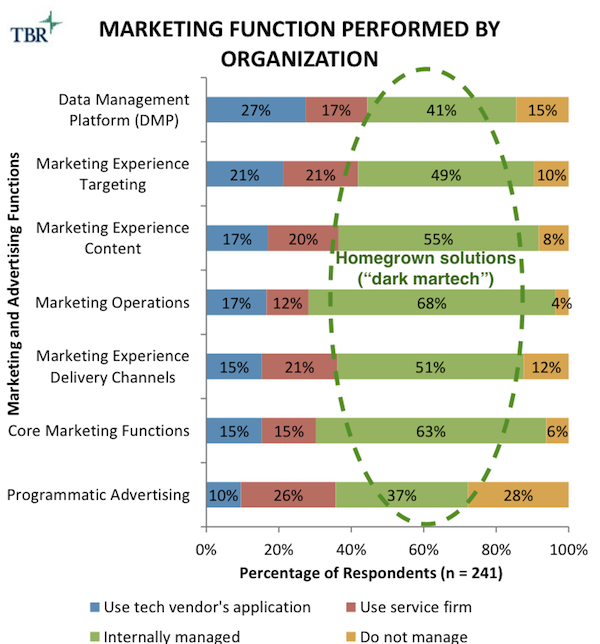
The following is a guest post by Seth Ulinski, senior analyst at TBR, talking about the phenomenon of “dark martech” — all the marketing technology that companies build themselves internally. This is one of the first studies I’ve seen that has attempted to quantify it.
There is no shortage of marketing technology (martech) solutions available to CMOs and their staff today. The number of vendors providing everything from point solutions to robust enterprise marketing clouds that attempt to solve an array of digital marketing needs is staggering, as seen in Scott Brinker’s vendor landscape.
Ironically, many organizations opt to manage the marketing function, and resulting data deluge, through homegrown tools or spreadsheets, as highlighted by more than half the respondents in TBR’s 2H15 Digital Marketing Services Customer Research (image at the top of this post).
Why are enterprises building homegrown or “dark martech” solutions?
- Change is difficult — siloed structures and budgets in companies reduce transparency across the organization.
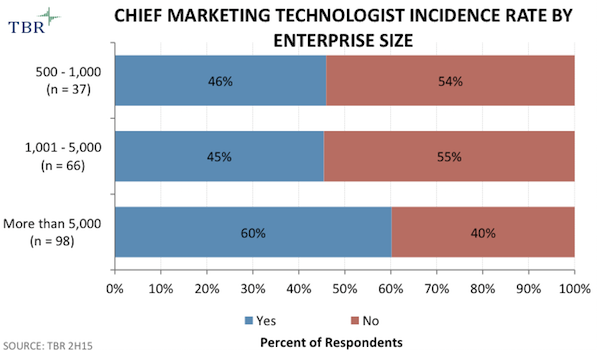
- Change must come from the top — or at least from an empowered CMO, or chief marketing technologist (CMT); note the correlation between CMT and cost center, seen in the figure below.
- Martech is in the early days of adoption — there’s a long way to go.
Many enterprises identified the value of a CMT in bridging the gap between marketing and IT departments as part of martech enablement. This is particularly true within large enterprises of 5,000 or more employees, as highlighted in this figure:
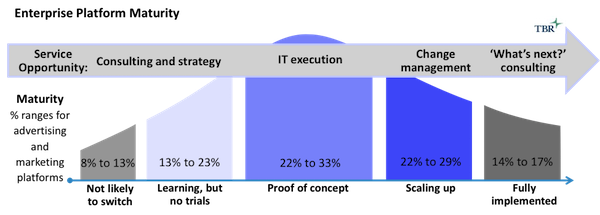
Martech platform adoption across enterprises is still in its nascent stage. According to TBR’s 2H15 Digital Marketing Services Customer Research, fewer than 20% of respondents indicated their companies have fully implemented solutions. This presents an opportunity for technology vendors and services firms to drive strategy and systems integration efforts.
Many companies decide to use homegrown tools because they are a known entity and provide a less-costly, less-risky option in the short term versus newer, untested tools. However, in the long term organizations that string together an assortment of tools will likely be challenged by data portability, interoperability and most importantly, the ability to compete in an increasingly competitive, always-on digital world. In this vein, a single data-driven source of the truth will be critical for intelligent, people-based marketing.
While martech directly benefits CMOs and their teams, deploying a unified martech stack can provide benefits to other business units:
- Marketing as an extension of sales — improves communication between known customers, prospects and suspects
- Marketing as an extension of customer service — messages smarter based on understanding customer
- Marketing as an extension of R&D — identifies needs sooner by enabling dialog with customers and prospects
While considering the drivers of an organization’s decision to work with internal tools, it’s worth noting the marketing function is still largely viewed as a cost center, per respondents to TBR’s 2H15 Digital Marketing Services Customer Research:
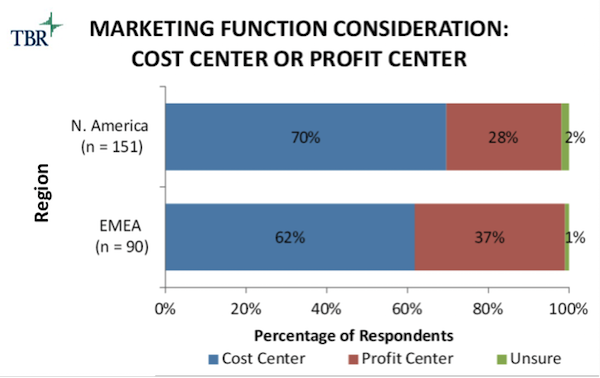
Organizations in EMEA (37%) are ahead of their North American peers (28%) in shifting the marketing function from a cost center to a profit center. This could be because EMEA-based companies tend to have fewer staff and may manage fewer platforms, making the task of marketing attribution less challenging.
As marketers look to build out their data-driven strategies (top-down and bottom-up) for this freshly minted notion of operating as a profit center, the marketers’ ability to understand how, where and when messaging has an impact (or does not) is just as critical.
Marketing teams with tightly integrated martech platforms pave the way for this profit-driving nirvana, leveraging engagement data across a variety of paid, earned and owned channels to maximize outcomes (e.g., sales, profit and brand equity). Companies opting to maintain a piecemeal approach or keep the status quo with legacy systems will likely have a more challenging time identifying the true impact of marketing investments. Meanwhile, advocates of advanced martech stacks will benefit twofold: They will be able to illustrate the value-add to the organization and they can set the stage for more relevant, meaningful engagement with consumers.
Thanks, Seth!
Get chiefmartec in your inbox
Join 42,000+ marketers and martech professionals who get my latest insights and analysis.